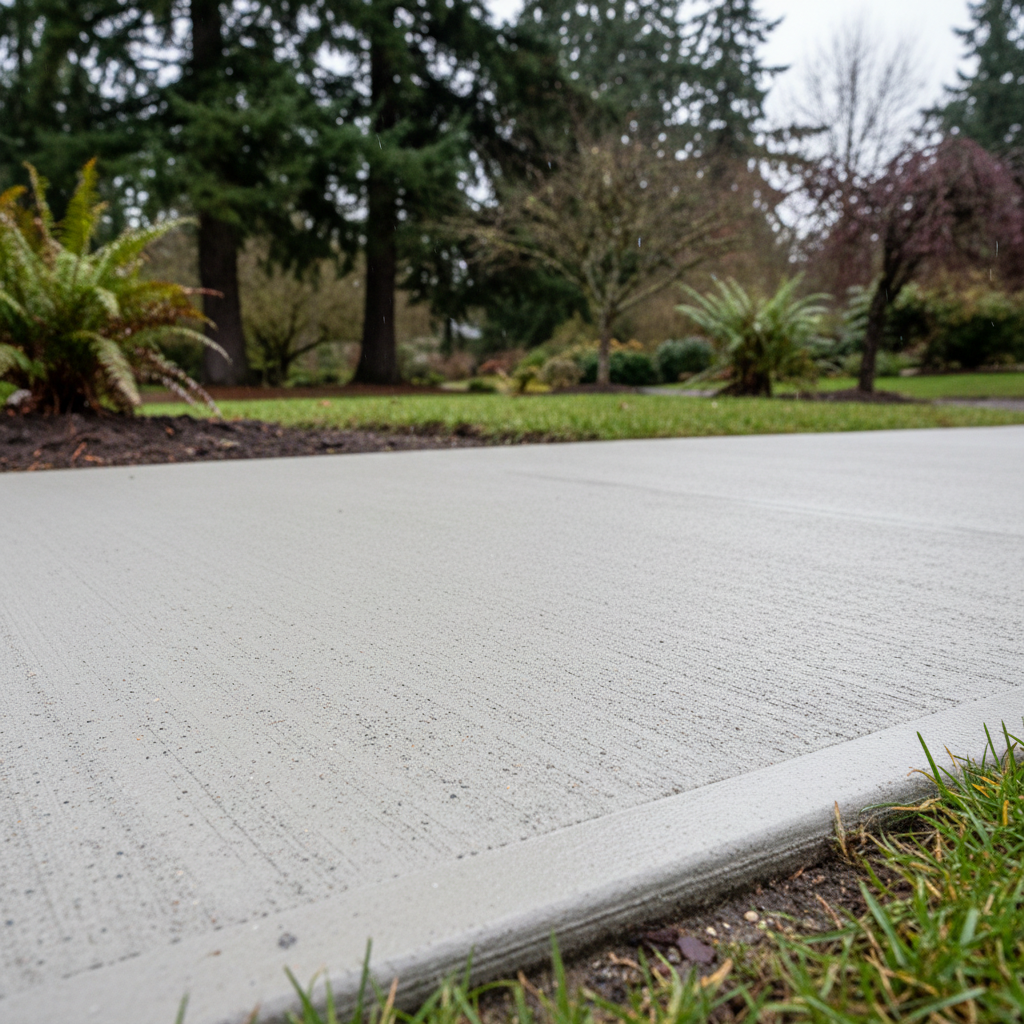
Your concrete sidewalks really take a beating, especially here in Lynnwood with our wet winters and those occasional surprise freezes. I get a lot of calls and questions about them, so I figured I'd put together some straight answers to what homeowners ask me most often. No fluff, just what you need to know.
How long should a concrete sidewalk last in Lynnwood?
This is a big one, and it's not a simple number. A well-installed concrete sidewalk, done right with proper sub-base prep and good quality concrete, should easily last 20 to 30 years, sometimes even more. I've seen some that are pushing 40, believe it or not. But there are a lot of factors that play into it. Our specific soil conditions here in Lynnwood, especially the clay-heavy areas around Scriber Lake, can cause issues if not properly addressed during installation. Tree roots are another huge culprit – those big maples and cedars we love can wreak havoc underground. Heavy foot traffic, poor drainage, and even just the quality of the original pour all make a difference. If it's cracking badly after only 5-10 years, something wasn't done right from the start.
What's the difference between patching a crack and full slab replacement?
Okay, so you've got a crack. First, don't panic. Not every crack means you need to tear everything out. Patching is usually a good option for hairline cracks or minor surface damage. We're talking about filling the crack with a specialized sealant or a concrete repair compound. It's a temporary fix for aesthetics and to prevent water intrusion, which can lead to bigger problems. But it won't fix underlying issues like soil movement or tree roots. Full slab replacement, on the other hand, is for when the damage is too extensive – wide cracks, significant heaving, crumbling, or multiple interconnected issues. If a section of your sidewalk is uneven and creates a tripping hazard, or if the concrete is spalling badly, patching just won't cut it. You'll need to remove that section and pour new concrete. It's more expensive upfront, sure, but it solves the problem for good.
Can I fix a sinking or uneven sidewalk section without replacing it?
Absolutely, and this is where I often recommend concrete lifting, or what we call 'mudjacking' or 'polyjacking.' Instead of tearing out and repouring, we drill small holes in the affected slab and inject a material – either a cementitious grout (mudjacking) or a high-density polyurethane foam (polyjacking) – underneath. This material fills the voids and gently lifts the slab back to its original position. It's much faster, less disruptive, and generally more cost-effective than full replacement. It's perfect for those sections that have settled due to soil erosion or poor compaction. We do a lot of this type of work at Guardian Concrete Solutions, especially around older homes in areas like the Lake Serene neighborhood where settling is common.
How do I prevent my sidewalk from cracking in the future?
Prevention is key! A lot of it comes down to proper installation, but as a homeowner, you've got some control too. Make sure you've got good drainage around your sidewalks; standing water is concrete's enemy. Keep tree roots in check – sometimes that means root barriers or, in extreme cases, removing a problem tree. Apply a good quality concrete sealer every few years; it helps protect against moisture, de-icing salts (if you use them), and general wear. And for goodness sake, don't use rock salt or harsh de-icers on your concrete in winter. They can cause surface damage, spalling, and accelerate deterioration. Use sand or a concrete-safe de-icer instead.
What's the deal with expansion joints and control joints? Do I need them?
You definitely need them. These aren't just decorative lines; they're critical for the longevity of your concrete. Expansion joints are full-depth separations that go all the way through the concrete slab. They're usually filled with a compressible material like asphalt-impregnated fiberboard. Their job is to allow the concrete to expand and contract with temperature changes without cracking. Without them, the concrete would push against itself and buckle or crack. Control joints (or contraction joints) are saw-cut grooves that are typically about a quarter of the depth of the slab. They create weakened planes in the concrete, encouraging any cracks that do form to occur along these lines, keeping them neat and controlled rather than random and unsightly. Any reputable contractor, like us at Guardian Concrete Solutions, will make sure these are properly placed and spaced.
When should I consider replacing an entire sidewalk versus just repairing sections?
This is a judgment call, but here's my rule of thumb: if more than 25-30% of your sidewalk sections are significantly damaged (major cracks, severe heaving, crumbling, extensive spalling), you're probably better off replacing the whole thing. Patching or lifting isolated sections is great, but if you're constantly chasing problems from one slab to the next, it becomes a money pit. Also, consider the overall aesthetic. If you're planning on selling your home or just want a clean, uniform look, a full replacement might be the way to go. Sometimes, the cost of multiple repairs starts to approach the cost of a full replacement, and then it's a no-brainer to just get it all done right at once.
What's the typical timeline for a concrete sidewalk project?
For a standard residential sidewalk project – let's say 50-100 linear feet – the actual work usually takes a few days. Day one might be demolition and sub-base prep. Day two could be forming and pouring. Then, the concrete needs to cure. You can usually walk on it after 24-48 hours, but it won't reach its full strength for about 28 days. We always tell folks to keep heavy vehicles off it for at least a week, ideally two. Of course, this doesn't include the planning, permitting (if needed), and scheduling. Here in Lynnwood, especially during our drier summer months, contractors get busy, so getting on the schedule can add a few weeks. Always plan ahead, especially if you want the work done during our prime weather windows.